
Firecrawl
Web scraping API that returns clean markdown for LLMs
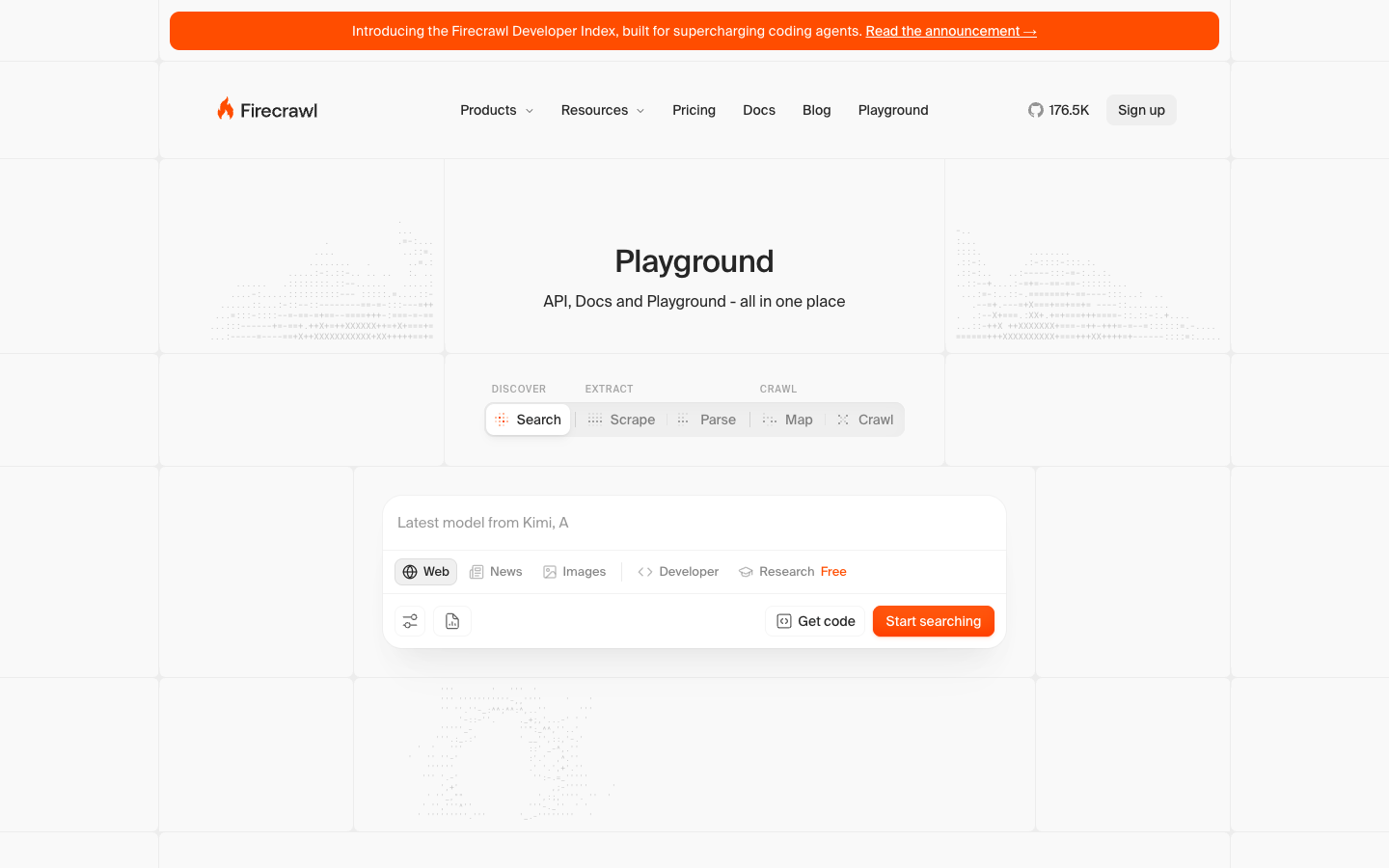
Firecrawl turns web pages into text a language model can use. One API call scrapes a page and returns markdown, HTML or structured JSON, handling the parts that usually break a scraper - JavaScript rendering, proxies, blocked requests, PDFs - without you running browsers. Beyond single pages, crawl walks a whole site, map lists its URLs, search queries the web and returns full page content rather than links, and an agent endpoint can interact with a page before extracting from it. There are SDKs for Node, Python, Go, Rust, Java, PHP, Ruby, Elixir and .NET, a CLI, an MCP server for driving it from an AI assistant, and webhooks for long-running jobs. The code is open source and can be self-hosted, and the cloud version is metered in credits: 1,000 a month free, 100,000 on the Standard plan, with concurrency limits rising by tier.
- Scrape a page to markdown, HTML or structured JSON
- Handles JavaScript rendering, proxies and PDFs
- Crawl a whole site, or map it to a list of URLs
- Search the web and get full page content back
- Agent endpoint interacts with a page before extracting
- SDKs for Node, Python, Go, Rust, Java and more
- CLI and MCP server for use from an AI assistant
- Open source, and self-hostable
Based on what people have said
Every answer links back to the mentions it came fromWhat are the primary use cases for Firecrawl?
Users employ Firecrawl for web research, content extraction, and gathering context for AI agents. It is used to scrape websites, crawl entire domains, and perform structured data extraction. Additionally, it is integrated into workflows for SEO auditing, monitoring competitor pages, and enriching data with other APIs.
7 mentions · @Eric_Kangg · r/Agent_AI · @AIGuide_ · @tom_doerr · @JulianGoldieSEO · r/ClaudeWorkflows · and 1 more · Aug 2026 – Sep 2026
How does Firecrawl compare to building a custom scraper with tools like Puppeteer or Playwright?
Some users prefer Firecrawl because it reduces maintenance compared to managing Puppeteer, which can become difficult to maintain when handling many pages. Others note that while Firecrawl handles browser rendering and cleanup, some developers still look for ways to let local LLMs drive a 'real' browser directly for more control.
2 mentions · r/Agent_AI · r/LocalLLaMA · Aug 2026 – Sep 2026
Is Firecrawl a free or paid service?
There is disagreement or confusion regarding pricing. Some users state that Firecrawl is a paid service, while others highlight the availability of a free, keyless plan that allows endpoint calls without registration.
4 mentions · r/Newsletters · @abimaelmartell · @CalebPeffer · @cbmenefee · Aug 2026
How reliable is Firecrawl for web scraping?
Experiences vary; some users report success using it for research and agent workflows. However, others note that like many vendors in the space, Firecrawl can fail on certain URLs, leading to retries and the consumption of credits.
2 mentions · r/Newsletters · r/LocalLLM · Aug 2026
These summarise counts and dates only. Read the quotes themselves under what people are saying.
What people are saying about Firecrawl
51% positive“Firecrawl, a four-year-old San Francisco startup that gives AI agents a single interface for searching the web, official data sources, and specialized indexes,”
“I was having a ton of issues with various providers for the movie watch. They were expensive, had gotchas, didn't do exactly what I wanted etc.”
“The best setup uses Firecrawl for live web research, Apify for deeper data workflows, website inspiration prompts, GitHub templates, Tailscale, and four token-saving playbooks.”
“At 1,800 the residential proxy bill alone was $210 a month and I was still losing a Saturday every fortnight to selectors, so Firecrawl at roughly the same money in March was an easy swap. Logged-in flows stayed on Playwright, the Firecrawl reply above is honest about that.”
“For basic public sites, APIs like Firecrawl or Jina are the easiest route and I'd start there. But if you need to fetch from logged in sites, social platforms, directories, or sites that block standard scrapers, a better approach is to run the fetch through your own active browser session.”
“one difference i did notice between the two i tried: firecrawl has the bigger ecosystem and an interact endpoint for clicking/filling forms before scraping.”
“My firecrawl VM is solely for firecrawl, all inbound connections blocked at hardware level, and I can monitor network activity globally.”
“self-hosted Firecrawl in its own VM is a reasonable extra crawler if you want one.”
“Worth knowing before you add another fetcher: the self-hosted Firecrawl docs say it doesn't include Fire-engine, which is the part that does the anti-bot work. So it won't fix the captcha problem, and Crawl4AI's stealth options change the browser fingerprint, not where the request comes from.”
“The self-hosted Firecrawl is decent too but I found it a bit heavy for what I need. For skills, I think the agent needs to know when to give up on a source and try another one instead of getting stuck on captcha walls forever.”
“I've come across Crawl4AI, self-hosted Firecrawl and webcmd, but I don't know if they're the right choices. They are so many different tools, it's not easy to find the right ones.”
“Without more details, I used Firecrawl API for search + fetch while job searching through various ATS platforms.”
“Just tell it to use browser use, firecrawl, camoufox. Etc”
“Firecrawl is more convenient for bulk content extraction, while Playwright is still stronger when you actually need to control the browser and handle complex UI flows”
“I was under the impression it scraps the web and converts to Md. if you already write it in Md what is there for it to do?”
“I landed on firecrawl because I’m often writing straight to markdown for use in an obsidian vault. Was told firecrawl is better for that, do you have any insight there?”
“→ Firecrawl - reads any site you hand it and pulls the brand identity, without burning tokens”
“Firecrawl handles more of that for you, although it can also be self-hosted.”
“The Firecrawl interact endpoint can help with that. But it's also possible to use Firecrawl scrape with browser actions if you know the site's element selector id's.”
“Brave looks cheap until the agent needs a follow-up scrape; Firecrawl looking good at 800–1500 only holds if that’s everything in the tool result, not just highlights. I’d measure: success rate × total tokens × latency for the same 25 queries end-to-end.”
“brave's cheap per hit but if it forces a follow-up scrape on a chunk of queries, you've already blown past firecrawl's single-call cost. did you track retry rate per tool alongside raw token count?”
“If you want an API that handles JS execution, proxies and gives you clean LLM-ready markdown in one call: Firecrawl is the best solution overall”
“The 800-1500 range for firecrawl is interesting but I’d want to know whether you're counting just the returned highlights or everything the API response puts into the tool result i think those can give pretty different numbers.”
“If you need full doc context and answers without blowing up your prompt cache with HTML bloat: Firecrawl is currently the most token-efficient drop-in for agents”
“I was not aware of all the tools Firecrawl now has to get the design information of a site. Very cool.”