
Doppler
Secrets manager that syncs config into every environment
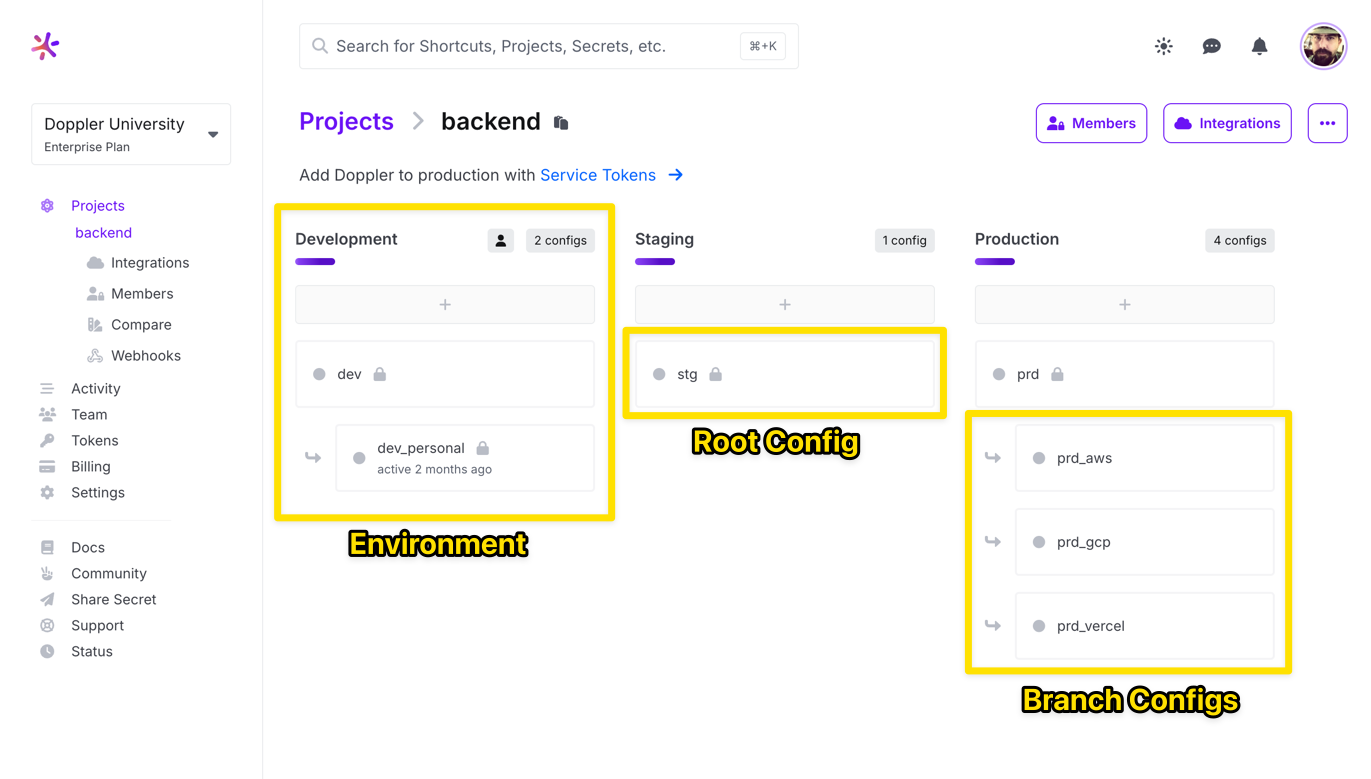
Doppler keeps API keys, database URLs and the rest of an application's configuration in one place instead of in .env files passed around a team. The CLI injects secrets into a process at run time, so local development uses the same values as everywhere else without a file on disk, and integrations sync those values into the platforms you deploy to. Secrets can reference each other, configs inherit from a parent so staging and production share a base, and service tokens and service accounts give machines their own scoped access. Paid plans add change requests for review before a secret moves, role-based access control, SAML SSO, trusted IPs and automatic rotation; Enterprise adds dynamic secrets, key management, log forwarding, SCIM and an on-premises option. Pricing is per human seat - the free tier covers three users and additional users are $8 a month - and AI agents and other non-human identities are not billed as seats.
- CLI injects secrets into a process at run time
- Integrations sync secrets to the platforms you deploy on
- Secrets can reference each other across configs
- Config inheritance so environments share a base
- Service tokens and service accounts for machine access
- Change requests review a secret before it moves
- RBAC, SAML SSO, trusted IPs and automatic rotation
- AI agents and non-human identities are not billed as seats
Based on what people have said
Every answer links back to the mentions it came fromHow does Doppler compare to other secrets management tools?
Users describe Doppler as easier to set up than HashiCorp Vault, noting that Vault can be a pain point for local propagation and RBAC management. Some users prefer Doppler over building their own solutions or using cloud-native managers like AWS SSM, though others find Doppler's pricing higher than AWS for a small number of keys. Some users have migrated away from Doppler to alternatives like Infisical, citing a preference for open-source tools that allow for self-hosting.
9 mentions · r/reactjs · r/webdev · r/websecurity · Hacker News · r/devops · Hacker News · and 3 more · Feb 2023 – May 2026
What are the common complaints regarding Doppler?
Some users find the secrets UI clunky when managing a large volume of secrets. Others have expressed difficulty understanding the documentation for specific integrations like GitHub Actions or Portainer. Additionally, some users are concerned about the inability to self-host the platform, and a few have questioned the security implications of storing secrets on a remote cloud server compared to local storage.
6 mentions · r/devops · Hacker News · r/node · r/selfhosted · r/devops · r/laravel · May 2021 – Aug 2025
How do users experience the setup and daily use of Doppler?
Many users report a positive developer experience, highlighting that it is fast to install and simplifies managing secrets across development and production environments. Users appreciate the ability to sync secrets automatically, which helps prevent build failures caused by missing keys. Some users note that it is particularly effective for small companies due to its ease of use.
8 mentions · r/reactjs · @thomasrice_au · r/PinoyProgrammer · r/statichosting · Hacker News · Hacker News · and 2 more · Mar 2024 – May 2026
Is Doppler considered secure?
Opinions vary; some users trust it for production environments, while others express suspicion due to the lack of publicly mentioned independent security audits. Some users have questioned whether it is safer than local storage and have noted that secrets can be viewed within the platform, suggesting that a model where the provider cannot see the secrets might be preferable.
4 mentions · r/websecurity · Hacker News · r/laravel · May 2021 – Mar 2026
These summarise counts and dates only. Read the quotes themselves under what people are saying.
What people are saying about Doppler
57% positive“Doppler is a great way to manage secrets. I'm liking it more the I use it. I wish they had a one-for-one replacement for 1password but:”
“Very interesting, so would you consider yourself more secure than other tools like doppler because of the split secret management? Are you going to build an MCP for this?”
“Doppler is the way here. Has worked great for us”
“\+1 on Doppler”
“Use Doppler Secret Share. It’s free.”
“We use Doppler”
“Only 1 things to say. Doppler”
“Just use Doppler. You’re into their free tier with 3 devs. Best DX I’ve seen for secrets management.”
“looked at enterprise tools like Doppler or HashiCorp Vault, but they feel like complete overkill for a tiny project and the configuration looks overly complex for what we need.”
“Aws has a secrets manager, as does google cloud and azure. Then there is infisical, doppler and vault. No good reasons to build your own and all the risks that comes with that”
“Doppler's fine for production but issue is devs committing .env files to git. Use .gitignore and never put actual secrets in local .env files during development”
“$20/month is quite a bit higher than AWS for a few keys. I don’t have any experience with Doppler, but it seems just like the other offerings I’ve seen. They don’t mention an independent security audit of their own system though….which makes me a bit suspicious if they are actually as secure as they mention.”
“I use doppler but idk if that's good enough.”
“A few differentiators:On open source: tools like Vault, Doppler, or Infisical are excellent but require setup, maintenance, and infra (or their hosted tier). KeyEnv's value prop is zero infra — install the CLI, run `keyenv run -- your-command`, done.”
“Never, ever expose the host docker socket to the agent's container.> Use a real secrets manager. Stop putting keys in .env files. Use tools like Vault, AWS SSM, Doppler, or 1Password CLI to inject secrets at runtime.> Practice the Principle of Least Privilege.”
“This looks like standalone Doppler (not a bad thing).”
“I went through all the list of suggestions here, Doppler is the best one and cheaper. Great solution and I love the sync with vercel”
“Started using @doppler for secrets management (API keys, etc) yesterday and thought it was an amazing experience. Fast to install, import keys, set up separate dev/prod environments, update live servers, etc.”
“(Just signed up for Doppler for secrets management in general yesterday and am finding them amazing so far.)”
“I rolled out the changes yesterday and used Doppler. So far, it's now cleaner and easier to manage on all places.”
“I haven't really made a setup that requires a secret at build time, so personally, I just let GitHub Actions build the image with no secrets at all, and the container just pulls all the secrets from Doppler when it starts. You just need to pass the token from Doppler.”
“You can also version your env files using a secrets manager like Doppler or 1Password Secrets Automation, so they sync automatically across environments. It saves a ton of time and prevents those “missing key” build failures.”
“Some folks use secret managers like Doppler — super handy once set up.”
“There are also tools like Doppler, EnvKey, or 1Password Secrets Automation that let you manage secrets centrally and sync them across environments. If you prefer something lightweight, even a simple GitHub Action or shell script can read from your local .env file and update your remote environments during deploys.”
“Check out HashiCorp Vault or Doppler, or if you’re leveraging CI/CD with GitHub Actions you can use GitHub secrets. Personally, I prefer Doppler. You can use it locally, in scripts, and integrate it with GitHub secrets.”