
Datadog
Observability and security across infrastructure, applications and logs
 1/3
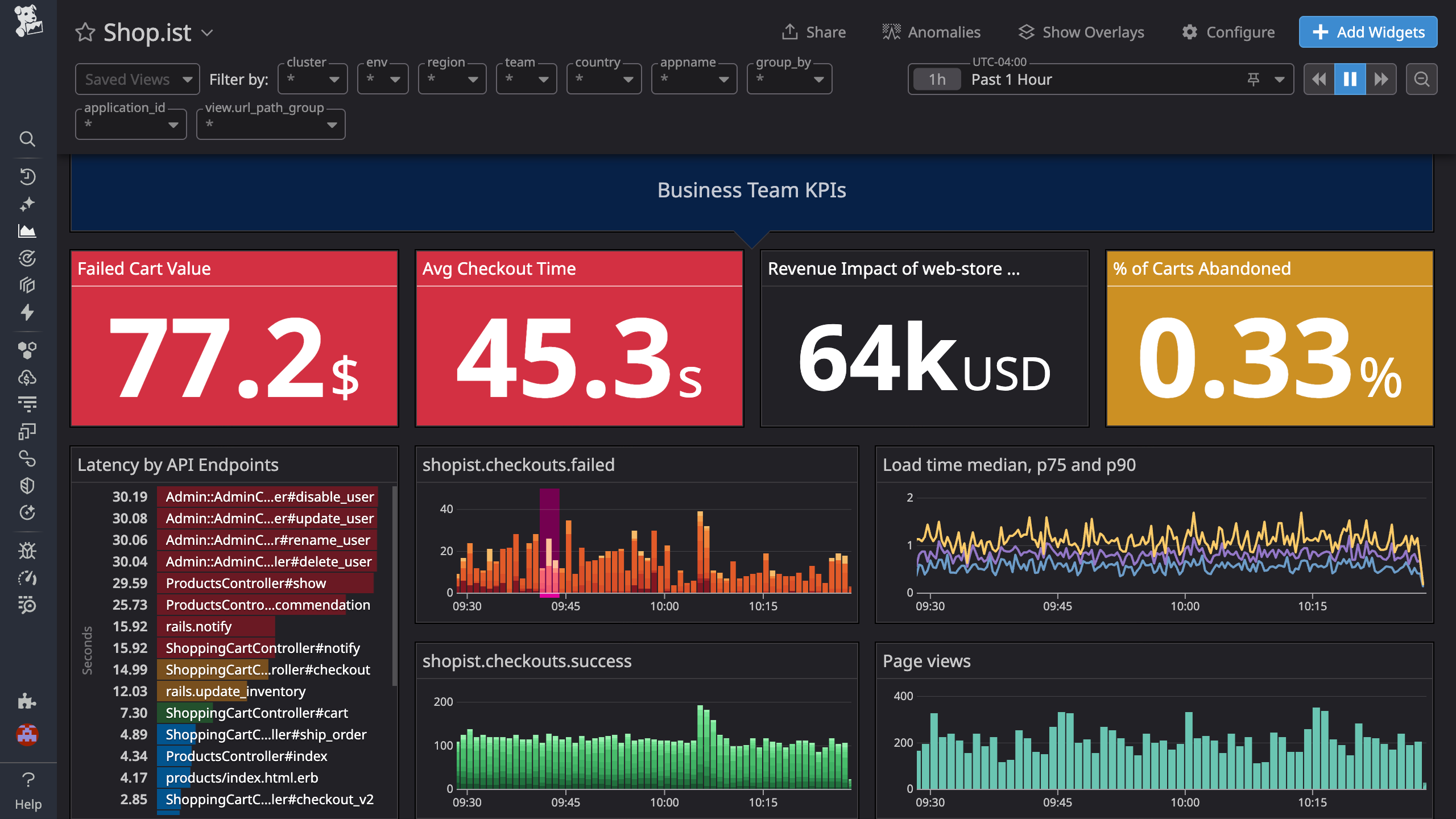
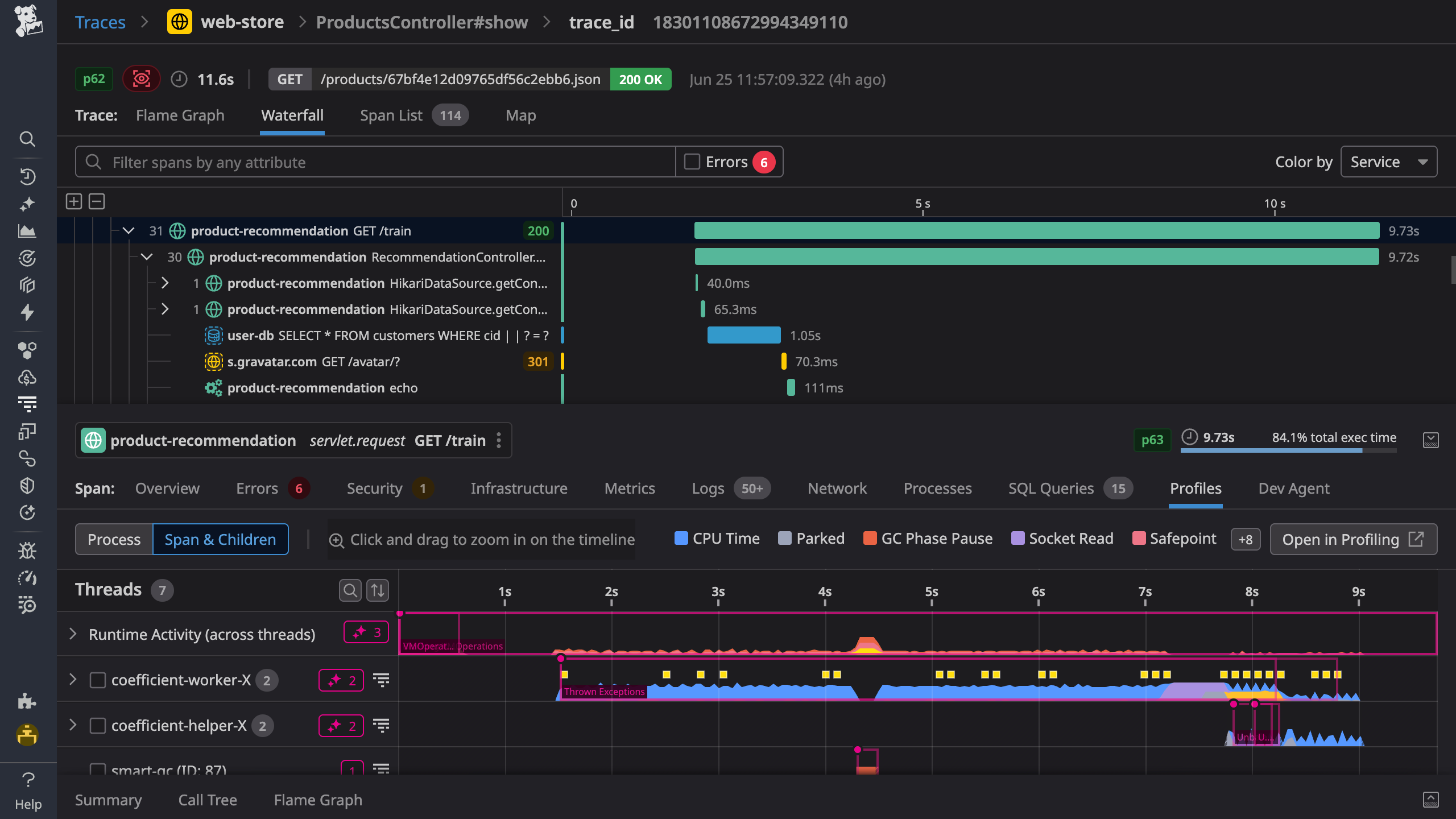
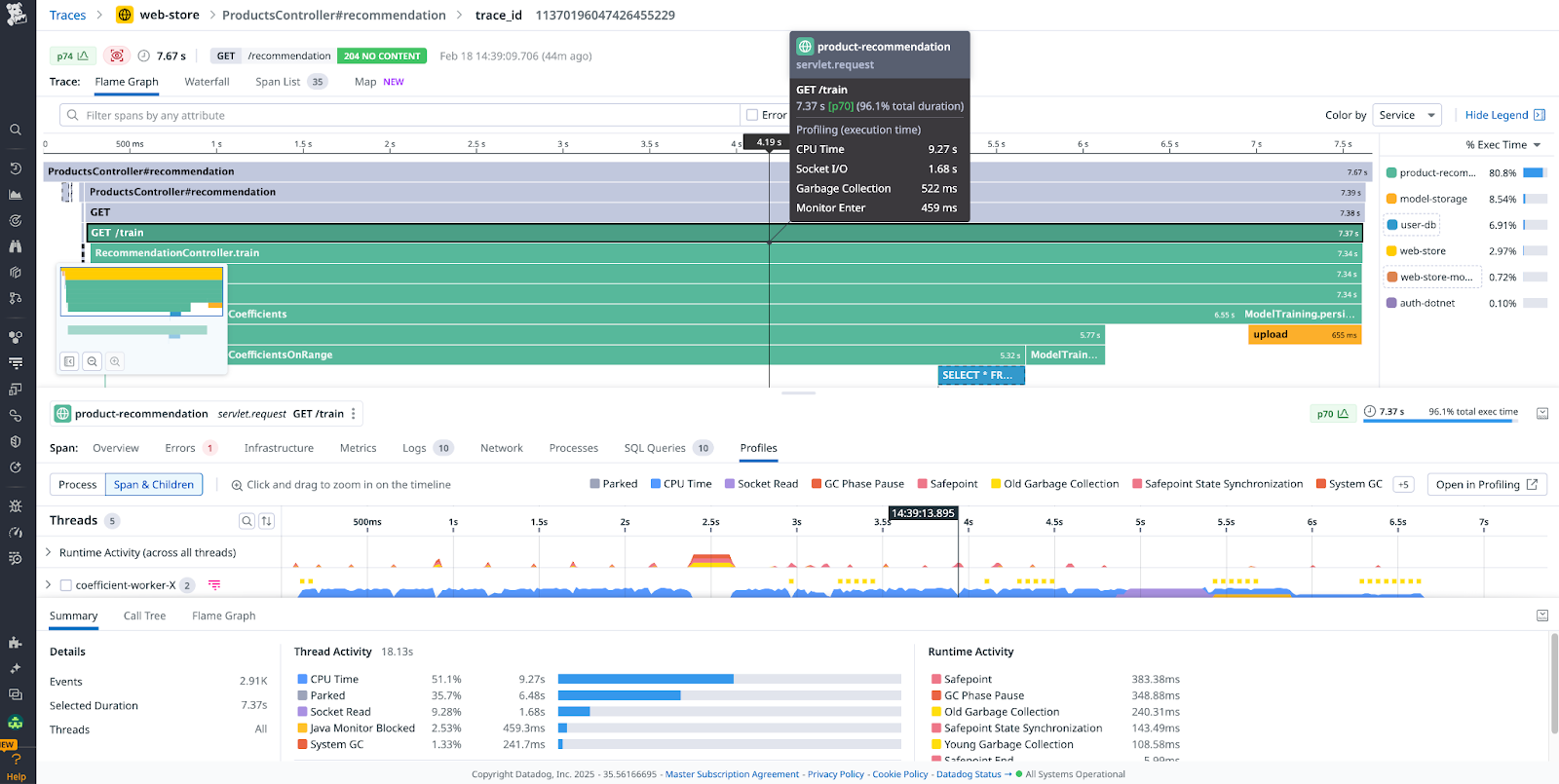
Datadog is a hosted monitoring platform that collects metrics, traces and logs from servers, containers, cloud services and applications and puts them on shared dashboards, so an on-call engineer can move from a graph to the trace and then the log line behind it without changing tools. An agent runs on the host or in the cluster, and more than a thousand built-in integrations pull in the rest. It is sold as modules rather than one price: Infrastructure Monitoring per host, APM per host, Log Management by ingested gigabyte and indexed event, plus Real User Monitoring, Session Replay, Synthetic Monitoring, Database Monitoring, Cloud Cost Management, CI Visibility and Test Optimization. A security line sits alongside, covering Cloud Security, Cloud SIEM, Code Security and workload protection. It is aimed at teams running distributed systems in the cloud. Pricing is per module and scales with hosts, ingested volume and retention, so the bill is worth modelling before committing.
- Metrics, traces and logs on shared dashboards
- Agent runs on hosts, containers and Kubernetes
- 1,000+ built-in integrations
- APM with distributed tracing and a continuous profiler
- Log Management priced apart for ingest and indexing
- Real User Monitoring and Session Replay for front ends
- Synthetic Monitoring runs scripted browser and API checks
- Cloud Security, Cloud SIEM and Code Security modules
Based on what people have said
Every answer links back to the mentions it came fromWhat are the common criticisms regarding Datadog's pricing?
Several users note that the service is expensive. Additionally, some report that forecasting costs is difficult because the bill is driven by telemetry volume rather than infrastructure changes, which is often not monitored as closely as infrastructure itself.
2 mentions · @brankopetric00 · r/FinOps · Aug 2026 – Sep 2026
How do users utilize Datadog for troubleshooting and performance optimization?
Users employ Datadog to trace logic across services, identify bottlenecks during load tests, and investigate issues as part of triage workflows. It is frequently integrated with other tools to help automate the identification and resolution of system spikes.
3 mentions · Hacker News · @karrisaarinen · @GreggLuskin · Aug 2026 – Sep 2026
How does Datadog compare to other monitoring or analytics tools?
Some users suggest that while Datadog is a standard for infrastructure and LLM trace correlation, other tools like UptimeRobot are necessary to provide an external perspective on user accessibility. Others compare it to Posthog, noting that Posthog is viewed as a strong alternative for AI observability.
3 mentions · r/LangChain · @uptimerobot · Sep 2026
What is the general sentiment regarding the Datadog recruitment process?
Candidates who have received offers from Datadog describe the recruitment process as professional and fast, with some individuals choosing to accept these offers over other opportunities.
4 mentions · r/leetcode · Sep 2026
These summarise counts and dates only. Read the quotes themselves under what people are saying.
What people are saying about Datadog
43% neutral“Great tool from Datadog for exploring cloud vcpu perf”
“Using the Datadog tracer to emit OTLP into an OTel Collector is a sensible migration bridge, especially when the priority is moving the backend without simultaneously changing every application.”
“If the buyer decides not to use Datadog how does that affect their ability to get changes or bugs prioritized in the SDK? Otel has a broader community and likely their vendor contributing so they know their vendor of choice will care and work to implement the change or fix.”
“Especially if you're still using Datadog as your backend, it seems like ripping out the Datadog ones for the sake of going vendor neutral is a little 'shoot-yourself-in-the-foot' if you lose things like profiling, and some other DD features.”
“Datadog CCM license change 2x cost increase.”
“Did you see a noticeable cost drop after moving off Datadog?”
“Essentially, you lose the fleet automation and control plane capabilities that Datadog offers you really only appreciate those features once you leave the DD realm.”
“They really do offer what is generally considered by new users to be the easiest to use platform with the widest capability set.”
“I would start working on getting the Datadog bill down, which is super easy to do, as most people just dump way too much into it "just in case". Work with your Datadog contact, they will help.”
“From what I’ve seen, they often take a long time to acknowledge their own issues (if they do it), and support is pretty poor when things go wrong.”
“Things you might miss from Datadog might be their APM capabilities. We built a grafana dashboard using span metrics from tempo to try and have a similar solution although not as feature rich.”
“I don't mind paying an extra 20/30% for the availability of a Saas solution and in the case of detadog the ease of configuring it and probably most of all the nearly perfect UI and UX.”
“At $25k / year, cut the check to datadog. You’ll have better business outcomes. The calculus only starts to shift around $10m / year.”
“My immediate thought is honestly that 300k a year isn't that massive and you'd likely spend close to that on running and maintaining an open source system by the time you factor in compute, storage, maintenance and people.”
“We recently migrated from Datadog to a stack based on Grafana + OTel Collector + VictoriaMetrics/Logs/Traces.”
“We migrated multiple clients from Datadog and Dynatrace to open-source observability tools.”
“Their salaries would need to be less than your yearly Datadog bill otherwise why bother.”
“Ours is quite big infrastructure with monthly Datadog spend around USD 25k and leadership is looking forward to reduce the spend and probably shifting it to OS observability system?”
“I'm currently using Datadog quite a bit at my job for request tracing, logging, etc. I feel ok with it, and I’d like to get a lot better.”
“Spent $4000 on tokens to save $20/mo on the Datadog bill”
“Most observability platforms support OTel: Datadog, New Relic, Grafana, Signoz, etc. The platforms themselves are worth evaluating yourself to see which one fits better for your org, but instrumenting with OTel will let you switch between them (or even route to multiple) without modifying code.”
“– Datadog (enterprise teams)”
“Anyone here using a live observability or debugging stack that actually helps with this, eg Datadog or similar, without too much overhead? Any hints?”
“Claude Code is making tons of calls to datadog while I use it, like 10+ per minute it seems. Normally I try to disable all telemetry on everything I use, especially on something that could have access to sensitive data. But I guess I just can't here.”
“The metadata already exists somewhere — Jenkins jobs know which repo+branch they built, datadog monitors are tagged with a service, pagerduty services map to a team. Glue those together with one mapping file.”